
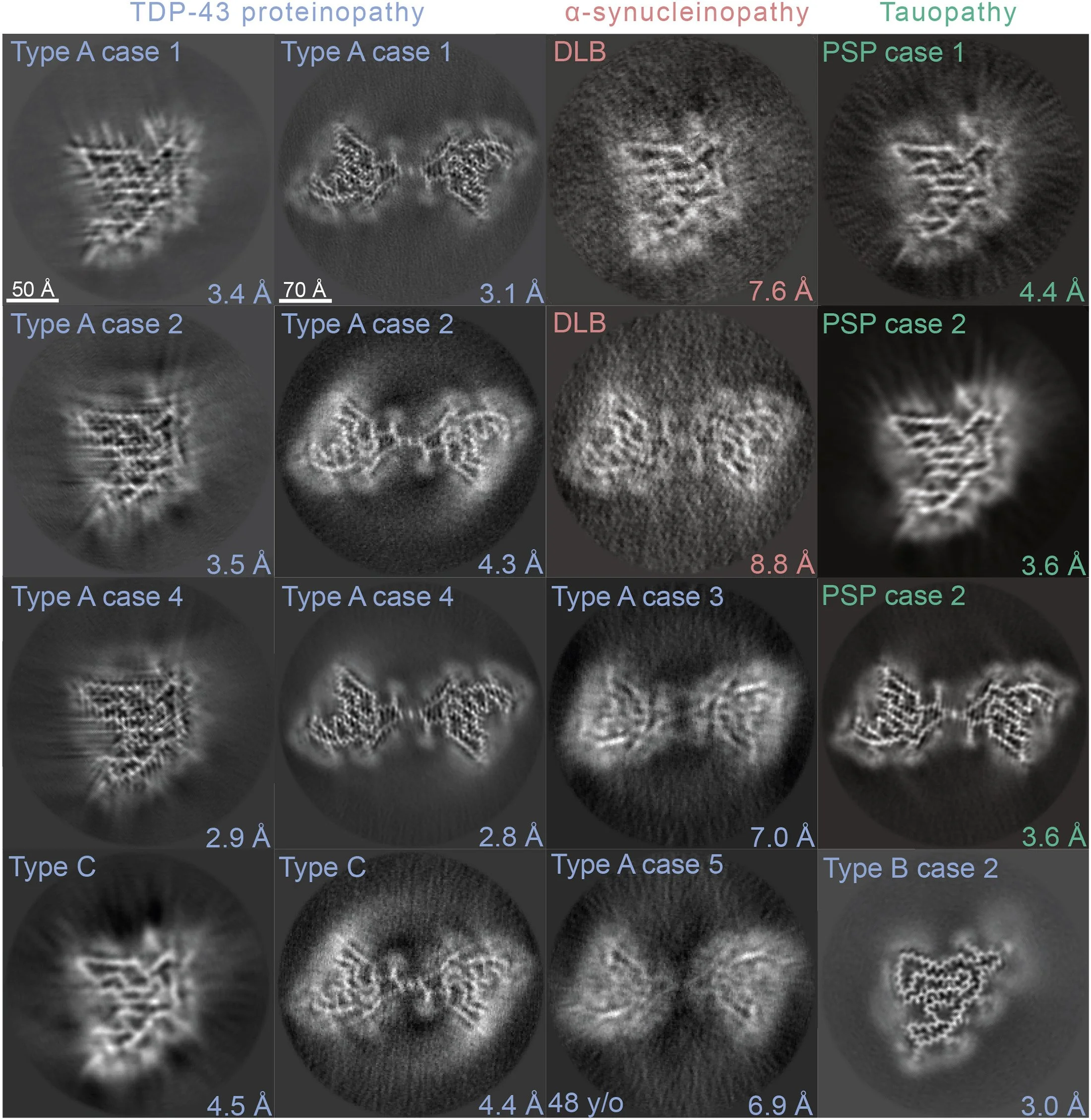
Chang et al., Cell, 03/2022; 185:1346-1355.
Cryo-Electron Microscopy of the Human Brain
Many of the most consequential protein states in biology exist only inside cells, where crowding, membranes, and active remodeling can reshape molecular structure and function. Cryo-electron tomography, or cryo-ET, provides a way to visualize macromolecular complexes and their interactions within vitrified cells and tissues in three dimensions. In the Fitzpatrick Lab, we use cryo-ET to connect molecular architecture to cellular physiology in the nervous system, with the goal of understanding how protein assemblies and aggregates reorganize neurons and glia in neurodegeneration and memory.
A major obstacle is access. Neurons and brain tissue are often too thick for electron transmission, so regions of interest must be thinned to well under a micron while preserving native ultrastructure. We address this challenge by integrating cryo-ET with cryogenic focused ion beam milling (cryo-FIB), which produces thin lamellas of vitrified cells or tissue that remain structurally intact. Using an Aquilos cryo-FIB, we prepare lamellas containing targeted cellular features and then image them by cryo-ET to reconstruct the molecular organization of cellular interiors.
This pipeline enables us to determine protein structures in situ and to visualize how fibrillar inclusions form, clear, and spread within the cellular milieu. We pair cryo-ET with quantitative light microscopy for cellular context and proteomics to link observed structural states to composition and interaction networks. Together, these approaches advance our broader mission to develop cryo-EM methods and apply them to fundamental problems in neurodegeneration, memory, and beyond.